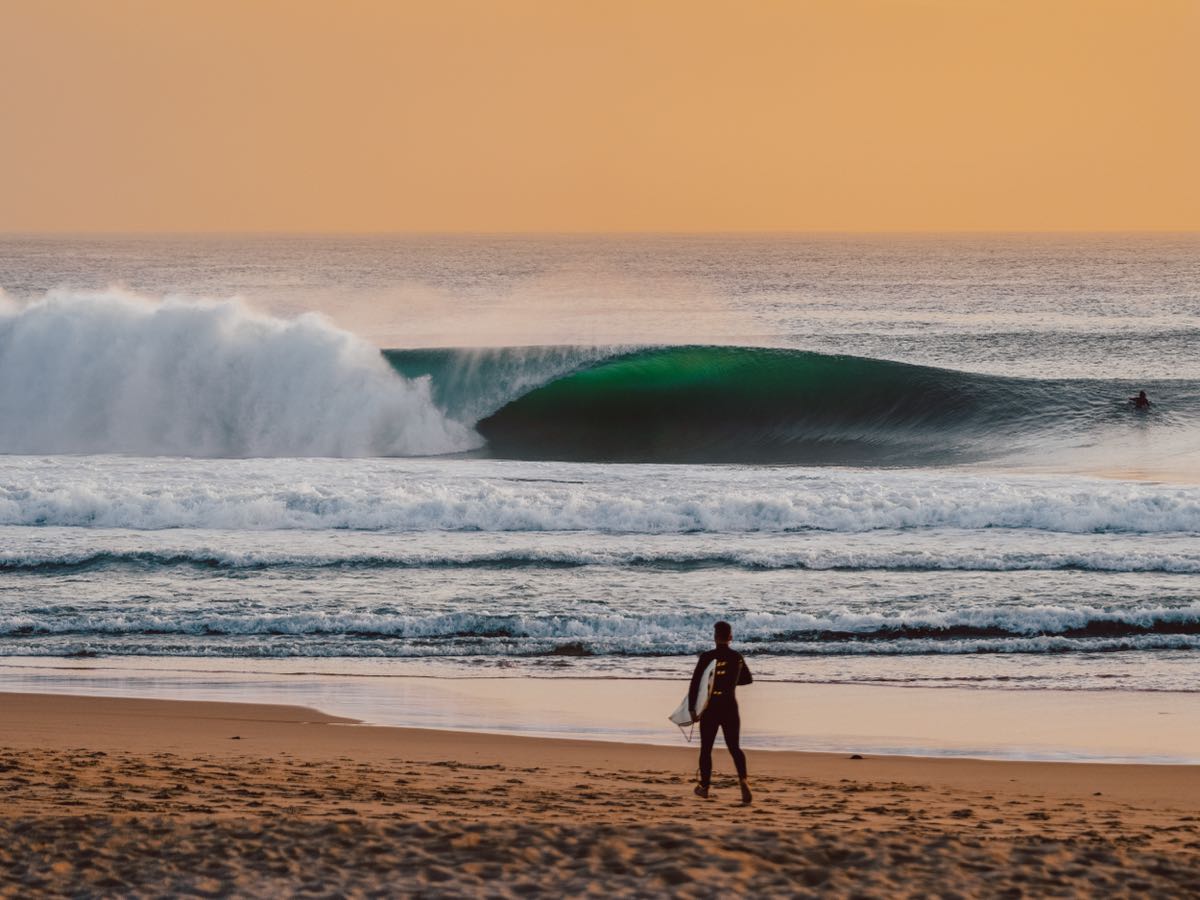
About an hour’s drive from Lisbon airport.
One or two of you? Surf lessonsWhat it costs
A week for your group, and nobody else.
The whole week, sorted.
No hidden line items, no scavenging for a board or a bed. Everything below is part of the camp — you just show up ready to surf.
- 7 nights
A house by the sea
Your group’s alone, all week.
- 6 lessons
Six surf lessons
Never more than five to a coach.
- 1 session
Surfskate
Train the turns on land.
- 30% off
Cheaper free-surf
Boards and wetsuits are in every lesson. Outside lessons, rental is 30% off.
- 1 film
Your drone film
An edit of your best waves.
- Optional
A day at Nazaré
Where the biggest waves ever surfed were ridden.
Per surfer, house included
Design your week
- Tell us who’s coming and which week
- Lourenço replies within 12 hours with your exact price and your house
- Nothing is paid until you confirm
Added. You’ll find it in step 4 of the form.
Where you’ll stay
The whole house for your group. Not a bunk bed.
Most surf camps put ten people in a room and call it the experience. We do the opposite: for the week the house is your group’s alone, with nobody you don’t know in the rooms or the kitchen. Most of our houses stand together at the Marlin Houses, on private land above the coast in Ferrel, with the ocean in view; Marlin House I is in Baleal village.
The usual surf camp
- A bunk in a room of eight or ten
- One shared kitchen for everyone
- Queueing for a bathroom
- A hostel, with boards outside
Marlin Houses
- The whole house for your group
- Your own kitchen
- Rooms for two, never a bunk
- Nobody you don’t know under your roof
The Marlin Houses in Ferrel
- Ocean view across the property — you can see the waves from the houses, so you know what the sea is doing before you have finished your coffee.
- A pool and a barbecue — for the afternoons when your shoulders have had enough and nobody wants to drive anywhere.
- Private parking — on site, off the road, with room for boards.
- Above the coast — private land, minutes from the water, quiet at night.


The houses
Whichever house, it’s yours.
You don’t pick a house in the form: tell us your group and your week, and we confirm which house is yours in our reply, before anything is paid.
The two-bedroom sleeps four. Right for a family of four or a small group of friends — the three-bedroom houses take up to six.
Design your weekA week, roughly
How the seven days tend to flow.
A rhythm, not a timetable — we move sessions to chase the best conditions. But most weeks look something like this.
Six surf lessons and one surfskate session sit inside the week wherever the ocean is best — we move sessions to chase the forecast. Weeks run Monday to Monday, so you check out on the Monday morning. Anyone in your group who doesn’t surf stays free and joins everything but the lessons.

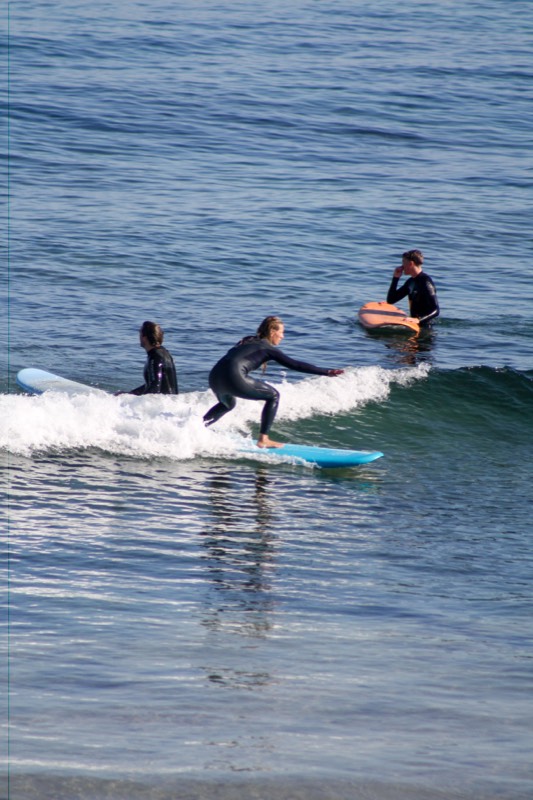

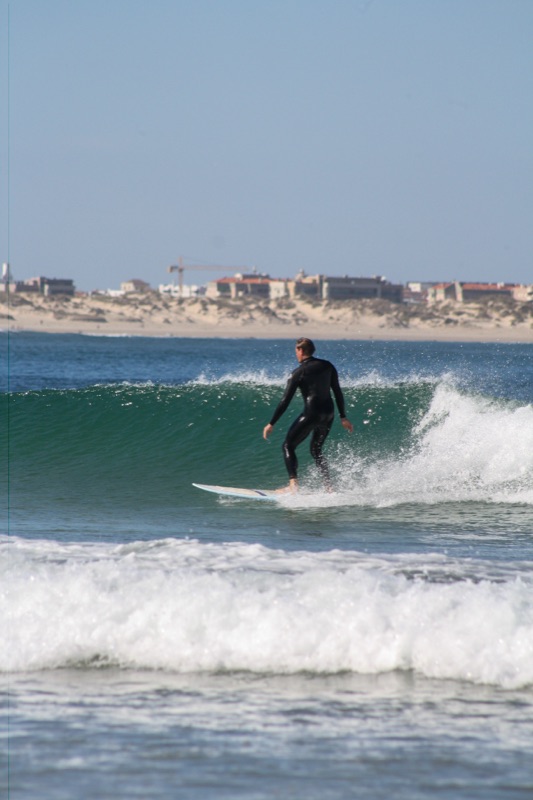
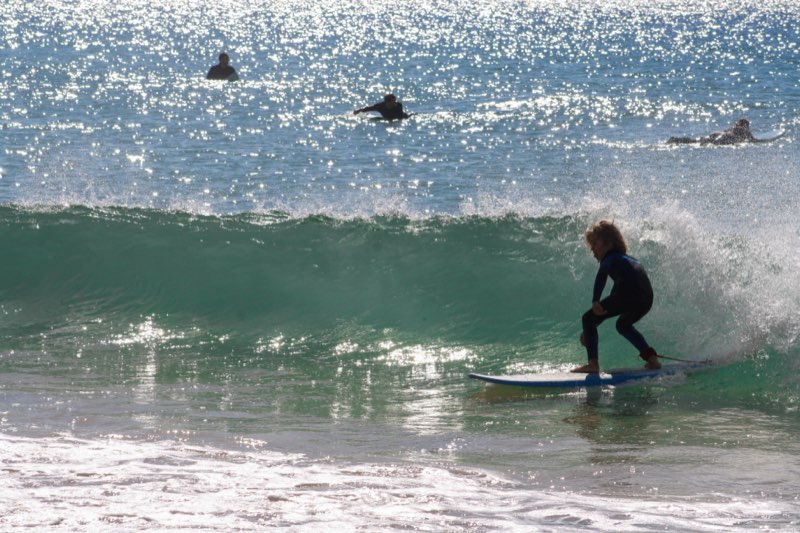
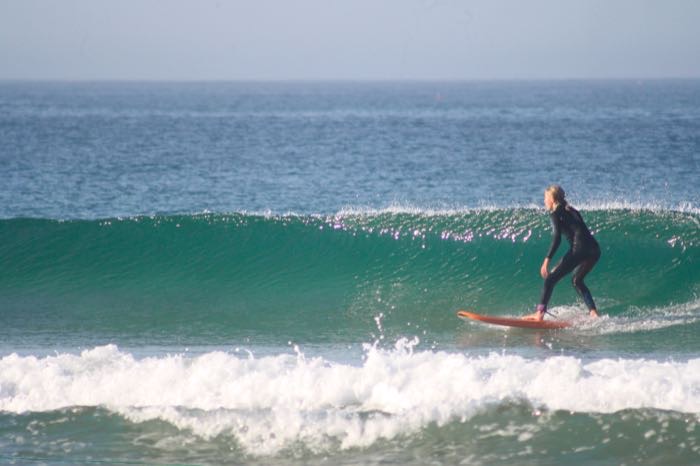
What you’ll actually remember.
And the parts that never fit a schedule
Your waves, from above
We film from a drone, and the best of your waves are cut into a film that is yours to keep. Seeing yourself surf for the first time makes a strange and very good evening at the house.
The session with no water
One session of the week is on a surfskate, on dry land. It is where a turn finally makes sense, because on tarmac you can repeat it as often as you like, and the sea only gives you one wave at a time.
The town after dark
A working fishing town, not a resort built around the waves. The walk down to Prainha, someone’s guitar on the terrace, everybody asleep early because the ocean is not negotiable at seven.
The drive up to Nazaré
An hour up the coast road to the lighthouse. The canyon that makes the biggest waves ever surfed sits a few hundred metres off that headland.
Ready to make it your week?
Optional extras.
The camp is complete on its own. These are the things people ask us to add — pick any of them when you fill in the form.
Tap any extra to see it up close. You can add them to your booking when you get there — nothing is charged now.

In their words
The part we can’t write ourselves.
Two coastlines
The wind rarely takes a day off you.
Peniche is a peninsula, not a straight coast. It has two shorelines facing opposite ways, so the wind that ruins one of them is the wind that grooms the other. When our side is blown out we walk the sand bar across to the far side and paddle out there. And if a day is truly lost, your lesson moves to another day of the week: your six lessons belong to the week, not to fixed days.
Discover every spot around Baleal


Why us
The proof is on the street signs.
Any camp here can show you a pool and six lessons. We can show you our family’s name on the street signs.
-
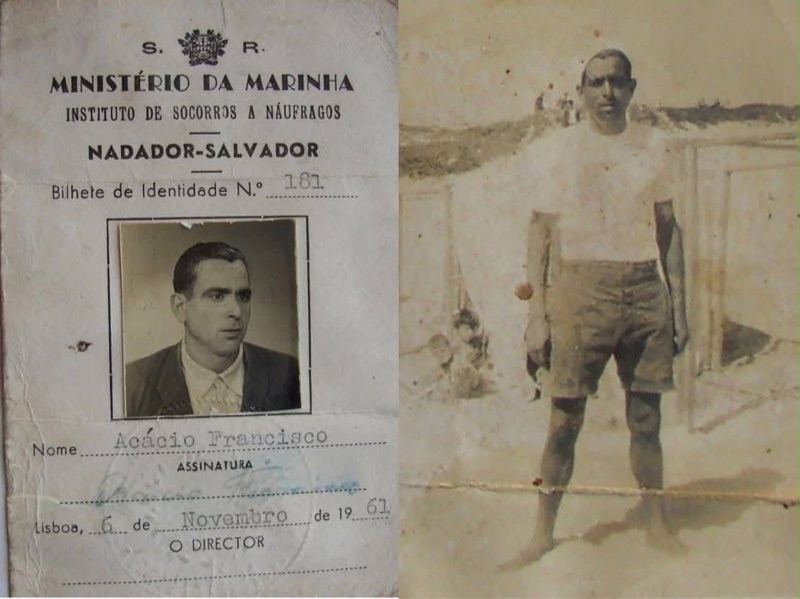
First lifeguard, 1961
Acácio Francisco Grandela fished this coast. On the sixth of November 1961 the Ministério da Marinha made him nadador-salvador number 181 — the first in Peniche. My grandfather, my father and my uncles worked as lifeguards on the beaches of Baleal after him.
The card itself, kept since the year it was issued.
-
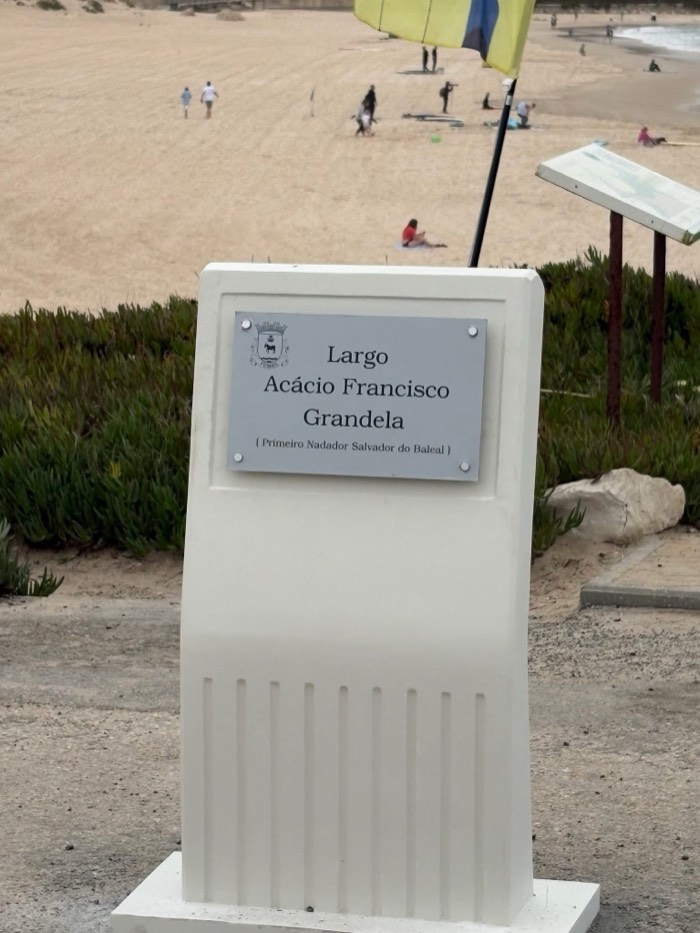
Our name on the square
Largo Acácio Francisco Grandela is the square at the entrance to Lagide and Prainha — the two beaches you are most likely to surf. There is a Rua Acácio Grandela on Baleal island too.
Largo Acácio Francisco Grandela · Primeiro Nadador Salvador do Baleal The marker at the entrance to Lagide — “the first lifeguard of Baleal”.
-
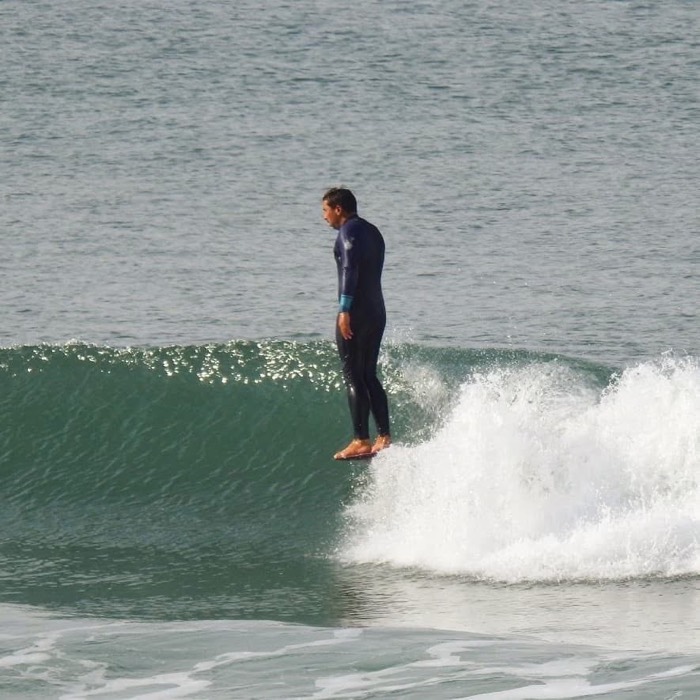
Multiple-time national champion
My uncle, Bruno Grandela, has won the Portuguese national longboard title more than once. Not a name borrowed for a website — he lives here, and he is in the water.
Bruno Grandela, hanging ten. Circuito Nacional de Longboard, Peniche.
-
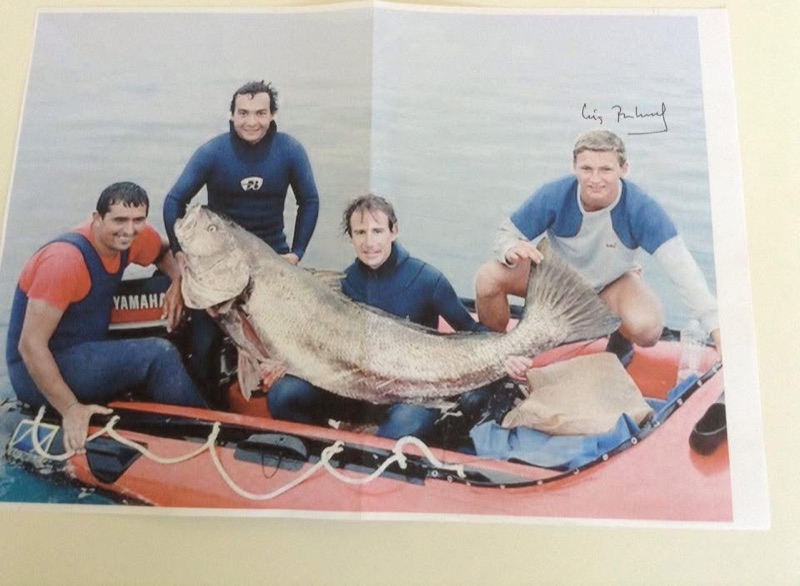
Percebes off the Berlengas
My other uncle cuts goose barnacles off the rock in the gap between two waves, nine miles out. He broke his leg doing it. He went back.
My grandfather and his friends, coming back in.
Four generations in, it is the same water. We just do something else in it now.
Read the whole storyThe table
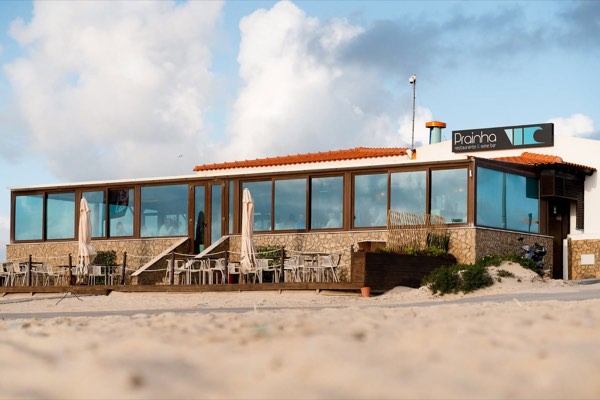
The family restaurant is on the beach you’ll surf.
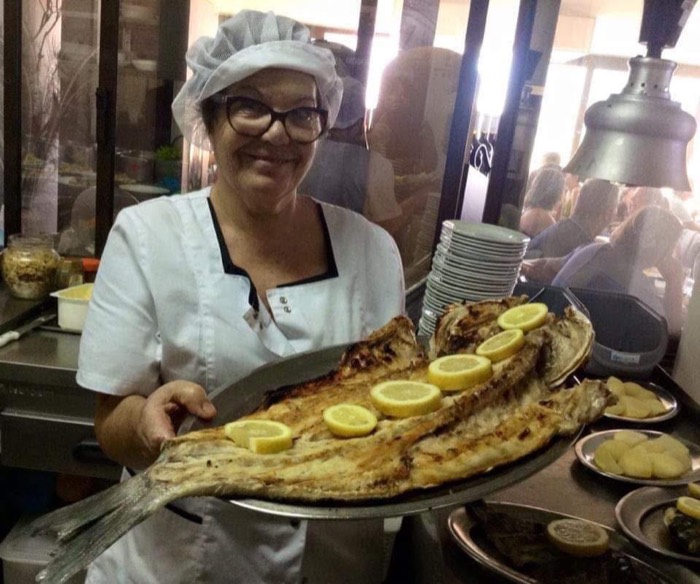
Most surf camps feed you catered food at a long table. Ours is a restaurant that has been in the family for generations, standing on the sand of the beach it takes its name from, with my grandmother as the chef. You are welcome to walk over if you feel like it.
The restaurant is called Prainha. So is the wave in front of it — the small, sheltered beach where very nearly everyone in this family caught their first one. The beach had the name first. We only cook under it.
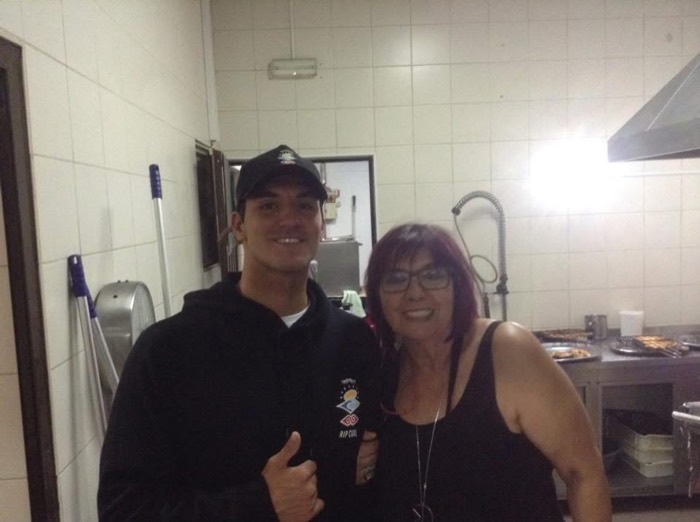
In the kitchen · Prainha
Three world titles have come through that door.
World champion · 2014 · 2018 · 2021
Gabriel Medina, with my aunt, in the kitchen at Prainha.
- It has been in the family for generations — it is not a caterer we hired, it is the family kitchen, and it was here long before the camp was.
- My grandmother is the chef — she has been, for as long as I have been alive.
- It is on the sheltered side — on the sand at Prainha, a short walk from the square that carries my great-grandfather’s name.
- The fish is the day’s fish — off the boats that morning, which is the whole reason people came.
Meals are not in the camp price. Your house has its own kitchen and you are welcome to cook, and Peniche is full of good places to eat. We put Prainha on this page because it is ours, and because you will eat better there than at anything we could cater. Nothing about it is compulsory and nothing about it is billed with the camp.
Before you ask
The questions that stop people booking.
Answered honestly, including the parts that are not flattering. If yours is not here, ask on WhatsApp — it is usually faster than the form.
The ones nobody says out loud
I’ve never surfed. Am I going to hold everyone up?Groups are split by level — never more than five surfers to an instructor.
No. Groups are split by level, not thrown together — never more than five surfers to an instructor, so a first-timer and someone working on their bottom turn are not in the same session waiting on each other. Complete beginners are welcome, and so are intermediate and advanced surfers who want coaching, video and someone who knows which beach to be at on the day. Lessons are taught in Portuguese, English or Spanish, by instructors certified by the Portuguese Surfing Federation (Federação Portuguesa de Surf).
Am I too old for this?If you can swim and you are in ordinary health, no.
Almost certainly not. Surfing punishes impatience far more than it punishes age — the paddling gets easier within days, and a coach’s job is to put you on waves that suit what your shoulders can do now, not to run a bootcamp. If you can swim and you are in ordinary health, this week is for you. If you have an injury or a condition you are unsure about, say so in the form and we will give you a straight answer rather than a brochure one.
What if the waves are too big for me?Then we go to another beach. The peninsula always has one.
Then we go somewhere else — and that is the whole reason this particular place works. Peniche is a peninsula pushed out into the Atlantic, with coastlines facing several directions at once. When one side is unmanageable, another is calm. We read the forecast every morning and choose the beach for the group, not for the photograph, and you will never be paddled out into something you should not be in. Saying no to a beach is part of the job, not a failure of the day.
One of us doesn’t want to surf. Is that awkward?They stay free and join everything but the lessons.
Not remotely, and you will not be the first. Anyone in your group who doesn’t surf stays in the house for free and joins everything except the lessons — the coast, the town, the meals, the evenings. Paid extras, like the Nazaré day, are priced per person if they want to come. Some people surf every single session; some surf twice and read for the rest of the week. Both are a good week, and nobody keeps score. In the booking form, just count them as guests and not as surfers.
Is it suitable for children, and from what age?All ages. Under-twelves are taught privately, and the camp price stays the same.
All ages — we teach everyone. The surf school takes children from five, and as a rule anyone under twelve is taught in private lessons, because at that age a coach’s full attention is the safety margin rather than a luxury. The price of the camp does not change: a child who surfs counts as one surfer, like anyone else. Tell us the ages in the form either way and we will say honestly whether the week you are looking at is the right one.
The practical answers
How do I get there from Lisbon airport?An hour by car, 1h10 by bus, or we collect you door to door.
Three ways, all straightforward. Drive — about an hour north, and a car is genuinely useful for chasing beaches on your own time. Bus — direct from the airport to Peniche terminal in roughly an hour and ten minutes for about €10, run by Rede Expressos, Citi Express and FlixBus; from the terminal it is a five-minute local bus or a taxi of around €15 to Baleal. Us — add the airport transfer in the booking form and we collect you door to door, €150 each way per van.
Where do we meet?At the Marlin House you are staying in.
At the Marlin House you are staying in. We come to you on the first day, and every morning after that we tell you which beach the day belongs to.
How cold is the water in November? Do I need a thicker wetsuit?17.7 °C — warmer than it is in May. A 4/3 wetsuit, included in your lessons.
Warmer than you are expecting, and no — a 4/3 full suit, which is ours, not something you need to buy. The sea off Peniche averages 17.7 °C in November. That is warmer than it is here in May, and more than three degrees warmer than March. People booking from northern Europe assume November means winter water; on this coast it does not, because the Atlantic gives the summer’s heat back slowly.
| When | Sea | What you’ll wear |
|---|---|---|
| July – October | 18.5 – 19.5 °C | 3/2 full suit; a shorty on the warmest days |
| November | 17.7 °C | 4/3 full suit |
| December – January | 15 – 16 °C | 4/3, with boots for a long session |
| February – April | 14.4 – 15.7 °C | 4/3 and 3 mm boots; a 5/3 if you feel the cold |
| May – June | 16.9 – 18.3 °C | 3/2 full suit |
What November genuinely costs you is weather, not water: it is the wettest month of the year here — around 104 mm spread over roughly thirteen days — with air between 12 and 17 °C. What it gives back is the best swell of the year, because November is the start of the surf season proper, a town with almost nobody in it, and the lowest rate we charge. Sea temperatures are NOAA satellite averages for Peniche; wetsuits, boots and boards are included in every lesson, whatever the month.
What happens if it rains all week?Rain changes nothing. Wind does, and that is what two coastlines are for.
You get wet slightly ahead of schedule. You are going into the sea in a wetsuit either way, and rain does nothing at all to a surf forecast — some of the best sessions of the year happen under grey sky. Even in the wettest month it rarely rains all day here; it comes through in bands and moves on. What actually stops a session is wind, and wind is precisely what a peninsula with two coastlines is for. If a day is genuinely written off, we move the session rather than cancel it: your six lessons belong to the week, not to fixed days.
What if the surf is flat?Very unlikely October to April — and small water is friendly water.
Between October and April, very unlikely — that is when the Atlantic is working. In the quietest part of summer the ocean can go small for a day or two, which is exactly what the surfskate session, the rest of the coast and the Nazaré day are there for. Worth knowing that small water is friendly water: a flat forecast is usually good news if you are learning, and only disappointing if you already surf well. If it is truly unrideable we move your lesson to another day in the week.
Do I need my own equipment?No. Boards and wetsuits are included in every lesson; outside lessons you rent at 30% off.
No. Boards, wetsuits, leashes and wax are ours and are included in every lesson. Outside the lessons they are not included: if you want to surf on your own, you rent them from us at 30% off, all week. Bring swimwear, a towel, sunscreen and warm clothes for the evenings — the mornings out of the water are colder than the water. If you own a board you love, bring it. If you do not, please do not buy one before the week: you will know far more about what actually suits you after seven days than before them.
What exactly is in the price, and what isn’t?Everything on this page. Not flights, meals, or the optional extras.
In: seven nights in a house that is your group’s alone, and for each surfer six coached surf lessons, one surfskate session, boards and wetsuits for every lesson, 30% off rental for free surfing, a drone film of your best waves, and the coaching and beach-picking every day. Not in: flights, your meals, and the optional extras — the Nazaré day, the jetski tour, yoga, jiu-jitsu, the airport transfer and the photo package. Every one of those is priced openly on this page and none is added unless you ask for it.
The price is per surfer for the whole week, with the house in it, and it is lower per surfer the bigger the group. A three-bedroom house takes up to six guests, a two-bedroom four. Seven or eight of you need two houses, priced on request. A week that spans two seasons takes the season of most of its nights, and the week of 31 December is priced as New Year.
How do I pay, and when?The house price confirms it; the rest is due 14 days before. Nothing is charged here.
A surf camp is confirmed by a deposit equal to the price of the house. The deposit is non-refundable, but it can be moved once to another free week, up to 30 days before your original arrival. The rest is paid up to 14 days before arrival, when the number of surfers becomes final. Bank transfer, MB WAY and PayPal all work. Nothing is charged on this website — you send the enquiry, we talk, and only then does anything get paid.
What if I have to cancel?The deposit moves once to another week; surf is refunded up to 14 days before.
If you cancel the whole camp, the deposit is kept and anything paid for surf packages is refunded up to 14 days before arrival. The deposit is non-refundable, but it can be moved once to another free week, up to 30 days before your original arrival. If some of the group drop out and the rest still come, each surf package given up is refunded up to 14 days before arrival, as long as at least three surfers remain; below three, the full price of a camp for three surfers is still due. The price per surfer depends on the size of the group: if the group gets smaller, the price is adjusted.
When do the camps run, and who are they for?Every week of the year, one group per house, from three surfers.
Every week of the year, Monday to Monday — the live calendar is in the booking form above, and a week that is already taken simply shows as booked. Each house goes to one group only: a family, a group of friends, two or three couples travelling together, from three surfers up. There are no bunk rooms and we never put people who don’t know each other in a room together, so the house is always yours alone. More than one group can be here in the same week, each in its own house. For one or two surfers, our surf lessons are the way in.
Can I come on different dates, or build something of my own?Yes — message us on WhatsApp and we will build it with you.
Yes. The camps run Monday to Monday because it fits the way the week is taught, but if your dates do not line up, or you want something built around your group, message us on WhatsApp. We answer quickly and we will put something together with you.
Anything still unanswered, ask it in the form above — or on WhatsApp, which is usually quicker and gets the same person either way.
Build your camp. We’ll do the rest.
Lourenço replies within 12 hours. No payment yet.
Dates not lining up, or want something built around your group? Message us on WhatsApp.