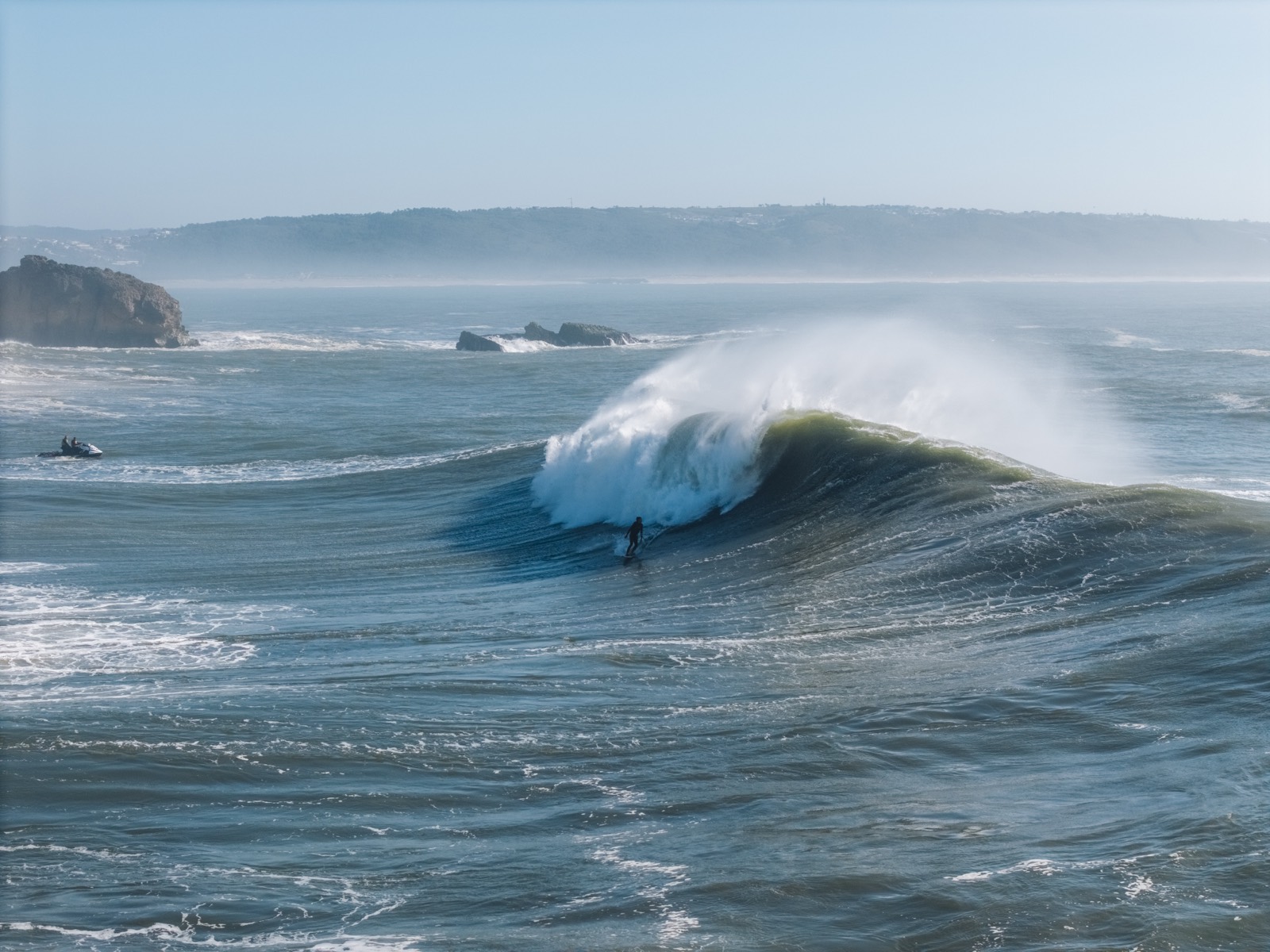
Fishermen here have always left the harbour before sunrise — not out of tradition, but because the wind is usually asleep until mid-morning. Surfers learned to keep the same hours for the same reason. Most of what looks like instinct on this coast is really just reading: swell, period, wind, tide.
Four words. Learn them and the sea stops being a mystery and becomes a forecast.
First
The anatomy of a wave
Your first lessons happen in the whitewater — the wave after it has already broken. It's softer, slower, and it pushes you politely toward the beach. The face comes later. The lip we leave to the photographs.
Second
Swell is a message. Period is how far it travelled.
A storm far out in the Atlantic pushes energy into the water. That energy travels for days as swell. The period — the seconds between waves — tells you how far it has come. Short period: messy local wind chop. Long period: organised lines from a storm a thousand kilometres away, arriving with real power underneath.
Swell generated near Greenland can take three days to reach Baleal. The waves you ride on Saturday may have been born on Wednesday, in a storm nobody here ever saw.
Third
Wind is the sculptor.
The same swell can arrive as art or as chaos. The difference is wind. Blowing from the land — offshore — it holds waves up and combs them clean. Blowing from the sea — onshore — it crumbles them into foam. This is why mornings matter, and why Baleal's two-sided geography is a gift: one side's onshore is the other side's offshore.
Fourth
Tides move the whole playing field.
Twice a day the Atlantic breathes in and out, and the beach changes shape underneath it. A bank that breaks perfectly at mid tide can vanish at high and close out at low. Same beach, same swell — three different waves in one day.
This is the part of the forecast apps are worst at and locals are best at. It's also why we choose your beach the morning of your lesson, not the week before.
The ocean doesn't have good days and bad days. It has hours. The whole craft is knowing which ones.
Worth knowing early
Rip currents — the river in the sea
Where waves push water toward the beach, it has to find a way back out. It gathers into a channel and flows seaward — a rip. Rips look deceptively calm: a darker, flatter corridor between the whitewater. That calm strip is a river moving away from land.
If one ever takes you: don't fight it straight back to the beach — that's swimming up a river. Stay calm, swim parallel to the sand until you're out of the channel, then let the waves help you in. On lesson days, we pick beaches and zones where this stays theory.